

JBN Blog
-
3 Basic Kettle Bell Moves To Burn More Fat During Your Workout!
The beginner's guide to kettle bell swings:
Most commercial gyms and nearly all private gyms have kettlebells available for the members to use. Kettlebells can be a very effective tool in strengthening and fat burning when used correctly. They offer an efficient way to transition from one movement to another without changing weights or machines. Kettlebells are not for everyone and will take some training to understand the movements and remain injury-free. I will go over this important movement and how to incorporate it into your workout.
The core movement with a kettlebell is the swing (shown below).
Kettlebell swings are a great way to improve conditioning, build hip and core explosiveness, and burn fat. This movement tends to be the most varied in technique due to poor instruction and/or poor hip mobility. I see too many people turning the swing into a “squat and lift”. This was made popular by the crossfit community and is actually a totally different movement than the kettlebell swing. The kettlebell should never travel overhead when doing a swing, instead, it should only raise as high as momentum from the hip thrust takes it. The arms should remain straight and the kettlebell should become an extension of the hands. The swing is more of a “pop” of the hips rather than a squat when the bell travels through the legs. Proper posture is extremely important, keeping the chest out, low back flat, and pushing the hips back. Sets and repetitions will vary based on the individual's conditioning, however, 15 plus reps is ideal for this movement.
Variations of the swing include: single arm swings, single arm with mid-air transition and double kettlebell swings (kettlebell of equal weight in each hand). Each version of the swing can be done as a separate exercise or as part of a superset or circuit. I will cover more kettlebell movements in later articles that can be added to circuits along with the swings.
Here are a few video's to demonstrate the movements.
Keep an eye out on more in depth explanations on how the kettlebell can be a permanent tool to add to each workout session!
See you soon!
-
5 Foam Rolling Essentials To Take Your Mobility & Recovery To The Next Level!

I’m sure you have seen foam rollers of various shapes and sizes in the gym and people flopping around on them like fish out of water, not really sure of the proper way to use them. Foam rollers are used primarily for self-myofascial release. That more or less translates to “self massage” meaning we are compressing the muscle/tendon to get rid of soft tissue adhesions or scar tissue. This is safer and easier than stretching!
Performing self-myofascial release will increase performance, lower the risk of injury, and improve mobility. Here are 5 uses for the foam roller that lifters of any level can use:
-
IT Band: Think of the IT band like a guitar string that runs from the hip to the knee and splits your quadriceps and hamstrings. This is connective tissue that is often excessively tight which would lead to lateral knee pain. Roll area for 30-60 seconds.
-
Quadriceps: Tight quads will contribute to knee pain and reduced performance. Roll area for 30-60 seconds shifting weight to inner and outer quads.
-
Piriformis: This is a muscle that is hard to pinpoint and usually falls into the “glutes” category. Tight Piriformis will lead to sciatic pain and reduced movement in the hip. This is one movement on the roller that will really show itself once you apply pressure to the specific area and not feel if you move just inches away from it. Roll area for 30-60 seconds
-
Thoracic spine extensions: T-spine extensions are not quite self-myofascial, but more of a mobility movement. Thoracic spine mobility is very important especially when working with strength athletes. Repeat twice
-
Pectoralis stretch: The roller can also be used for a great chest stretch. This opens up the chest and allows for greater range of motion and better posture. Hold stretch for 60 seconds.
These five easy movements on the roller will improve your performance and function. Be sure to start with a softer roller which is more giving and then move onto something more dense once your body adjusts.
Happy rolling!
-
-
3 Benefits of Selenium That You Wish You Would Have Known About Sooner!

There is a long list of advantages supplementing with Selenium brings to the table. Too many to list for a quick read in fact... We’re going to keep this short and sweet so you’ll know right off the bat if Selenium is something that you may want to start incorporating into your daily nutritional regimen.
Selenium is a trace mineral found in some foods, soil and water. As populations have grown exponentially over the last few decades, agriculture has been forced to keep up. Science has discovered new ways to grow crops faster and at the same time, provide more food for populations but at the expense of soil degradation. Our plants and other earth grown crops simply do not have the full spectrum of vitamins and minerals they once had.
In highly density populations, Selenium deficiencies are on the rise, leading to a mass amount of complications that affect our bodies at the core.
Selenium, Boron and Magnesium are among the top 3 minerals we're deficient in as a country. Supplementing with these may not seem like a big deal or seem like it will make a big difference, but the outcome once the body adapts to having adequate levels to help it function properly are nothing short of exceptional!
The following 3 benefits make this a stand out mineral!
-
Selenium helps combat cancer: Research from Cornell University and Arizona shows that supplementing with Selenium and Chromium together helps to significantly reduce the spread of cancer in the liver, prostate, colorectal and lungs. Selenium binds to glutathione (an extremely powerful antioxidant) and works on the repair process of damaged DNA which helps to significantly reduce the growth of tumors and cell mutation. (source)
-
Selenium helps regulate thyroid function: “Adequate nutritional supply of selenium, together with the two other essential trace elements iodine and iron, is required for a healthy thyroid during development and adolescence, as well as in the adult and aging populations.” (source). “The most frequent disease involving the thyroid gland is the autoimmune chronic thyroiditis, an inflammatory process which progressively destroy the gland. Several studies have examined the potential benefits of Se in this disease to assess if its supplementation may be effective in increasing the antioxidant defenses.” (source)
-
Selenium acts as a potent anti-inflammatory defense mechanism: When partnered with Vitamin E, Selenium proves to be a catalyst in helping to reduce the conditions of rheumatoid arthritis, psoriasis, lupus, and eczema.
The benefits extend far beyond the scope of these 3 key takeaways in the article. Use the vast wealth of knowledge out there to compile your own bulleted list of reasons why you should look into supplementing with Selenium!
-
-
6 Easy Steps To Help Diminish Joint Pain

Are troublesome or painful joints keeping you from your favorite activities or exercises? In a National Survey, about one-third of adults say they experience joint pain within a 30 day cycle and joint issues only become more common as you get older (WebMD). Joint pain or discomfort is the result of injury in the tendons or ligaments surrounding the joint or can even be related to arthritis. Joint pain can also be associated with and bring about inflammation at the site of the pain. The ultimate goal of treatment is to reduce the pain and inflammation, and to preserve joint function (WebMD).
Inflammation is the body’s natural immunity defense to harmful stimuli. Once Inflammation begins, so does the healing process of that specific area (Medical News Today). Specifically, chemicals from the body’s white blood cells are released to protect your body from foreign substances and that in turn increase blood flow to the area. The increased number of inflammatory substances is what causes joint irritation and the swelling of the joint lining (WebMD). The diagram below shows how inflammation can cause swelling and may eventually lead to wearing down of the cartilage.
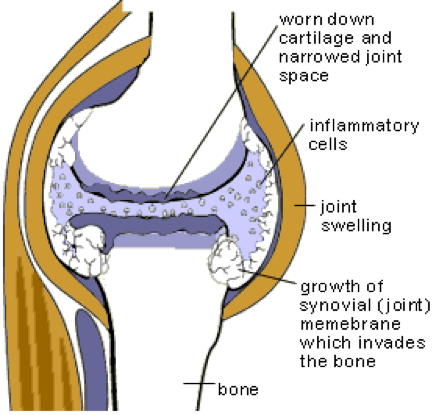
In order to combat your aching joints, we provided 6 essential steps that can prevent and help nullify the pain and get you back on track to engage in your favorite physical activities.
-
Stay Active and Exercise Regularly.
Staying active and being in motion can help prevent joint pain or stiffness. Minor exercise and properly warming up can make all the difference when dealing with joint support. Even if you are not engaged in vigorous physical activity, changing positions while sitting behind a desk at work, or while watching TV can maintain healthy joints. For those who exercise regularly, it is also important to remember to regulate your exercises to allow you to move within your joint pain limit and do not increase the pain or cause further injury. Also to remember is that with more regular exercise the stronger and more flexible your joints will become.
-
Cryotherapy
When you first start to feel pain in your joints, applying an ice pack to the affected area can do wonders to dull the pain. When cold temperatures are applied to the sore or painful area, it will reduce the blood flow to that area. When the blood flow is reduced, it will in return, reduce the swelling in that area. At the start of the pain, doctors will recommend to ice the affected area for approximately 15 minutes every hour or as often as you can throughout the day. The next day will require you to ice the area for 15 minutes about 4 to 5 times a day.
(Gaiam Life)
-
Diet Modifications
Avoiding inflammatory foods is a key step. Highly processed foods can result in an increase in inflammation in the body. High doses of gluten, trans fat, and sugars in food can all cause inflammation that will ultimately lead to more aching pain. Adjusting your diet to compensate for anti-inflammatory foods will provide the nutrients needed to prevent pain and build up your cartilage and ligaments that will support healthy joints.
Here’s an example of an anti-inflammatory diet plan:
Breakfast: 2 organic eggs cooked in 2 tsp. of butter with a half of a sweet potato and 1 cup of spinach.
Morning Snack: Half of an apple with 2 tbsp. of peanut butter and 2 oz. of nitrate-free deli meat.
Lunch: 4-6 oz. of grilled salmon, half-cup of wild rice with 1 cup of steamed vegetables and 2 tsp. of butter.
Afternoon Snack: 2 oz. chicken leg, 2 small tangerines and 16 almonds.
Dinner: 4-6 oz. of grass fed beef, half-cup of squash, and 2 cups of green beans sautéed in 2 tsp. of coconut oil.(Nutritional Weight and Wellness)
4. Nutrients In addition to maintaining a healthy diet - making sure your body gets the correct supplements can also help a tremendous amount when dealing with joint pain. Here at JBN, we have made products specifically geared to help your aching joints and to maintain your future health. JBN Joint Support is an exclusive all-in-one formula that can help alleviate periodic inflammation, maintain normal joint tissue
integrity, and may be useful for people suffering from symptoms of osteo-arthritis and stiffness. It also helps maintain proper levels of the inner joint fluids which ensures proper movements. It contains Glucosamine and Chondroitin Sulfates, two powerful nutrients that help support healthy joints and connective tissues. Other ingredients include the anti-inflammatory actions of MSM, Boswellia and Quercetin along with the collagen sustaining properties of Vitamin C, and Proline. Bromelain, ginger and turmeric have been included to help reduce the risk factors of age-related bone and joint conditions.
Inflammove plays the hero of multiple roles in the body. It's packed with research-backed ingredients that help with fluidity and mobility of joints and ligament repair as well as a healthy dose of Tumeric which helps supply the joints with fresh, oxygenated blood. Tumeric is also the unsung hero of many other key benefits which just make taking Inflammove an even smarter choice!
-
Hydrotherapy
Warm or hot water therapy will ease the pressure on joints and muscles by stimulating blood flow. By taking a warm bath, a warm towel, or a heat pad and applying it to the affected area for 15 minutes for approximately 4-5 times a day can alleviate the pain. Alternative methods that proved successful (Dr. Axe, Food is Medicine) are using a hot and cold approach following one another. For example: Apply a heated pad to the affected area for 15-20 minutes and then immediately apply a cold ice pack for the same duration to bring relief. Another way to combat your joint pain and inflammation can be to run a warm bath with Epsom salts. The magnesium and other important sulfates will be absorbed throughout your body and will reduce inflammation and help you on the road to recovery.
-
Weight Management
Being overweight can put extra unwanted stress and strain on your joints and bones. We’re not saying that you have to completely change your body or get down to the ideal weight, but even the smallest amount of change in weight can make a huge difference. Having extra stress on your joints can also lead to accelerated bone degeneration over time. Finding a routine that will contribute to weight loss would be the ideal solution.
Another major issue with joint mobility is Arthritis
Arthritis is a chronic degenerative condition of the joints. There are two distinctive forms of arthritis: osteoarthritis and rheumatoid arthritis (OA-RA). OA has no known cause but research has found that is related to aging and heredity. OA affects the joints in your body while RA is a chronic autoimmune disease with an unknown cause. In RA there is an inflammation of the joint lining. The joint lining becomes thick and interferes with joint mobility.
Arthritis is one of the most common reasons people give for limiting physical activity. Many people who have arthritis are less fit, weaker and less flexible and have more pain than necessary due to the complications of inactivity. Pain, stiffness, fatigue and the fear of doing harm can make it difficult to be physically active with arthritis. For the person with arthritis, however, an appropriate exercise program is very important.
Research shows that many people with arthritis can participate in a regular exercise regimen. One of the first things to think of is stretching. Gentle, low intensity exercises performed daily to maintain or improve range of motion are the foundation of most therapeutic exercise programs and also are important in recreational or fitness exercise.
Second, is strength and conditioning, these are more vigorous than flexibility exercises and are usually done every other day. They are designed to ask the muscle to work a bit harder than usual. This extra workload may come from lifting the weight of the arm, leg or trunk against gravity, or using weights, elastic bands, or weight machines for more resistance. Muscles adapt to the new demands by getting stronger and/or becoming capable of working longer to decrease pain in the joint.
Third, the most important, is cardiorespiratory exercise. These include activities that use the large muscles of the body in rhythmic and repetitive movements. Aerobic exercise improves heart, lung and muscle function. It is also the kind of exercise that has benefits for weight control, mood and general health. Examples of aerobic exercise are walking, swimming, aerobic dance, aquatic exercise, bicycling or exercising on equipment such as treadmills, rowing machines, Nordic track or elliptical trainers. Daily activities such as mowing the lawn, raking leaves, sweeping the driveway, playing golf or walking the dog are also aerobic exercise depending on the intensity level.
By utilizing aerobic exercise you start to build lean muscle tissue that will reduce excess pressure on the affected joints. Remember the best way to help relieve arthritis is to have comprehensive management (seeing a doctor, physical therapist, exercise physiologist, and the most appropriate nutrition etc).
-
-
5 Great "Finishers": Do These Exercises to Help Break Up Lactic Acid In The Muscles After Your Workout!

Are you tired of mindlessly trudging along on a cardio machine for 30 minutes after your workout?
Here are 5 great "finishers" that burn more fat, strengthen the core, and take a third of the time!
Finishers are a fun way to end a workout. They combine cardio and core strengthening movements. The ones talked about here will need a small piece of "equipment" and a little space to perform. Most gyms will have a stretching or ab area. If you are lucky, there will be a spot with artificial turf or a group exercise classroom to use. The piece of equipment needed to perform these finishers are simple furniture movers, or "sliders". Sliders can be found in all shapes and sizes, from your typical furniture movers (used only on artificial turf, carpeted floors or large rugs) to discs that are designed for hardwood exercise classroom floors or any type of hard, smooth surface. If you do not have access to either of these, two kitchen or hand towels (one for each foot) work just fine on hard, smooth surfaces!
Mountain climbers: these work core and give your quads a serious burn! Rep ranges from 20-100, slow down the pace to fatigue quads more. In the image below, you can see the position of your body and with each rep you switch legs as if you were climbing.
Plank with hip abduction/adduction: make sure to keep core tight and not let hips sag. 10-30 reps will cause serious burn!
Hip/knee tucks: keep most of the bodyweight on the hands and make sure your butt stays up! When you kick the legs back out, don't let the hips sag. 10-20 reps.
Alligator walks: not for the weak, these test core, shoulder stability, tricep strength, and endurance. Hold the body flat and don't move the legs. Increase difficulty by not stopping when turning around. Slowly increase reps and/or distance travelled.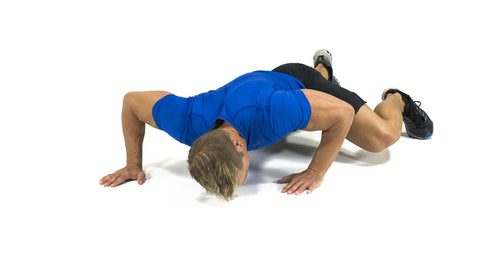
Slider "pushes": the opposite of alligator walks, keep the hips up and drive from the balls of the feet. Speed and stopping ability is something to consider when doing this in a confined space!
You can perform these as individual movements or as a circuit.Good luck and enjoy!
About George- George has a BS in Sport and Exercise Science from DeSales University and obtained his CSCS from the National Strength and Conditioning Association. He has over 10 years experience working with a wide range of clientele from top-level athletes to older adults and special populations. He also is a competitive powerlifter and enjoys coaching the sport.


